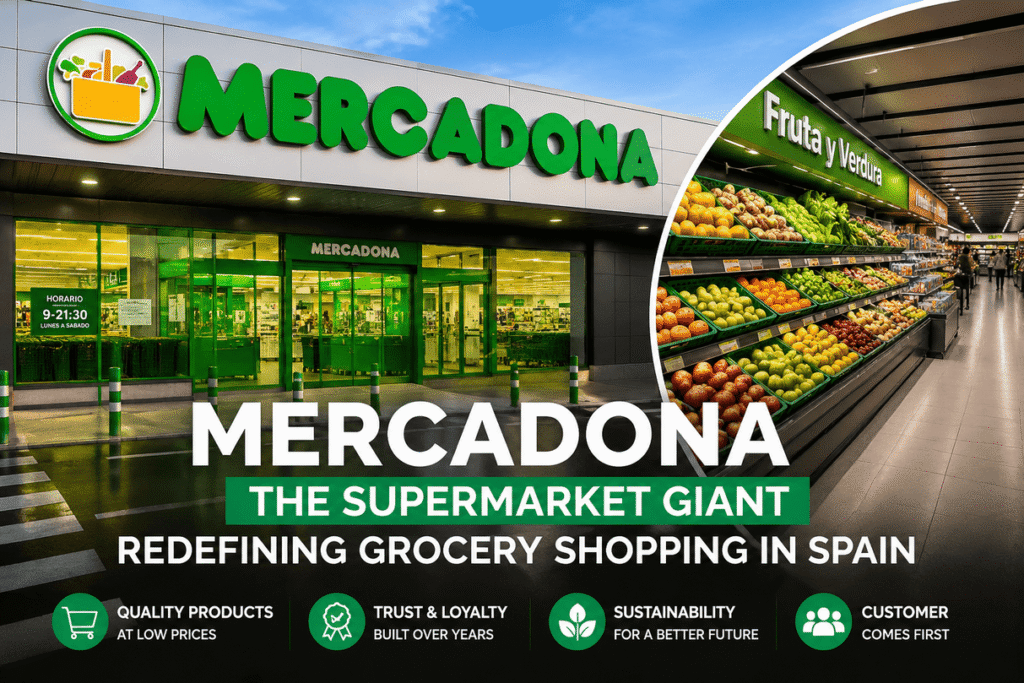

When people talk about grocery shopping in Spain, one name dominates the conversation: Mercadona. What started as a modest family-owned butcher business has evolved into one of Europe’s most influential supermarket chains. Today, Mercadona is not just a supermarket — it’s a cultural phenomenon shaping how millions of people shop, cook, and think about food.
From affordable private-label products to efficient store layouts and surprisingly loyal customers, Mercadona has mastered something many retailers struggle to achieve: trust.
In this deep dive, we’ll explore why Mercadona continues to dominate Spain’s retail market, how its business strategy differs from competitors, and what global retailers can learn from its success.
What Is Mercadona?
Founded in 1977 by the Roig family in Valencia, Spain, Mercadona has grown into Spain’s largest supermarket chain. The company operates thousands of stores across Spain and Portugal and serves millions of customers every month.
Unlike many international retailers that expand aggressively worldwide, Mercadona has focused on dominating its local market first. That disciplined strategy helped the company build one of the strongest retail brands in Southern Europe.
Quick Facts About Mercadona
| Feature | Details |
|---|---|
| Founded | 1977 |
| Headquarters | Valencia, Spain |
| Industry | Retail / Supermarkets |
| Employees | 90,000+ |
| Countries | Spain & Portugal |
| Known For | Private-label products, customer loyalty, efficiency |
Why Mercadona Became So Popular ?
Mercadona’s success didn’t happen overnight. The company built its reputation by understanding everyday consumers better than many competitors.
1. Affordable Prices Without Sacrificing Quality
Many shoppers first visit Mercadona because of pricing. But they stay because the quality consistently exceeds expectations.
Its private-label brands — especially Hacendado, Deliplus, and Bosque Verde — have become household names in Spain.
These products often compete directly with premium international brands at significantly lower prices.
2. The “Always Low Prices” Strategy
Unlike supermarkets that rely heavily on weekly discounts and aggressive promotions, Mercadona follows a more stable pricing approach.
This strategy creates trust because customers know prices remain competitive year-round without needing coupons or loyalty tricks.
It also simplifies shopping psychologically. Customers spend less time hunting for deals and more time buying what they actually need.
The Mercadona Store Experience
One thing many first-time visitors notice is how organized Mercadona stores feel.
The aisles are clean. Product placement is intentional. Staff members are visible and often helpful.
This isn’t accidental.
Mercadona invests heavily in operational efficiency and employee training. Their philosophy focuses on what the company calls “The Boss” — their term for the customer.
That customer-centric approach influences nearly every decision inside the business.
Key Features Shoppers Love
- Fast checkout systems
- Consistent product availability
- Fresh bakery and produce sections
- Easy-to-navigate layouts
- Strong private-label alternatives
- Clean and modern store design
Mercadona vs Other European Supermarkets
Mercadona competes with major international retailers like Carrefour, Lidl, and Aldi.
But its strategy differs in important ways.
| Feature | Mercadona | Lidl | Carrefour |
|---|---|---|---|
| Main Strength | Customer loyalty | Discounts | Product variety |
| Private Labels | Extremely strong | Strong | Moderate |
| Store Design | Simplified | Compact | Large hypermarkets |
| Pricing Style | Stable | Aggressive discounts | Mixed |
| Local Market Focus | Very high | Medium | International |
Mercadona doesn’t try to be everything for everyone. Instead, it focuses on simplicity and reliability.
That focus has helped it outperform many larger global competitors in Spain.
The Secret Weapon: Private Labels
Perhaps Mercadona’s biggest strength is its private-label ecosystem.
Instead of overwhelming shoppers with dozens of similar products, Mercadona carefully selects fewer options and improves them constantly.
Popular Mercadona Brands
| Brand | Category |
|---|---|
| Hacendado | Food & beverages |
| Deliplus | Beauty & personal care |
| Bosque Verde | Cleaning products |
| Compy | Pet food |
Many Spanish consumers now actively prefer these brands over global alternatives.
In fact, some Mercadona beauty products have gained viral popularity online because users claim they perform like luxury skincare at budget prices.
Mercadona’s Online Shopping Expansion
Like many retailers, Mercadona accelerated its digital transformation after the pandemic years.
Its online shopping platform improved significantly with:
- Faster delivery systems
- Better mobile usability
- Dedicated logistics centers
- Real-time inventory updates
Although it entered e-commerce later than some competitors, Mercadona focused on building a system that prioritizes efficiency over flashy features.
That practical mindset reflects the company’s overall philosophy.
Sustainability and Environmental Goals
Modern shoppers increasingly care about sustainability, and Mercadona has adapted accordingly.
The company has invested in:
- Reduced plastic packaging
- Energy-efficient stores
- Improved recycling systems
- Sustainable seafood sourcing
- Logistics optimization to reduce emissions
According to the company’s sustainability reports, Mercadona continues investing heavily in environmentally responsible infrastructure.
Areas of Sustainability Focus
| Initiative | Purpose |
|---|---|
| Energy-efficient stores | Lower electricity use |
| Smarter logistics | Reduce transport emissions |
| Packaging reduction | Less plastic waste |
| Recycling systems | Better waste management |
Consumers now expect retailers to balance affordability with environmental responsibility. Mercadona appears determined to meet both demands simultaneously.
Employee Culture: An Overlooked Advantage
One of Mercadona’s most underrated strengths is how it treats employees.
Retail jobs are often associated with low wages and high turnover. Mercadona took a different approach.
The company became known in Spain for:
- Competitive salaries
- Extensive training
- Career development opportunities
- Long-term employee retention
This matters more than many people realize.
Happy employees generally create better customer experiences, and Mercadona stores often reflect that difference.
Challenges Facing Mercadona
Despite its dominance, Mercadona still faces major challenges.
Rising Competition
Discount chains continue expanding aggressively across Europe.
Retailers like Lidl and Aldi remain strong competitors because inflation-sensitive consumers often prioritize price above all else.
Digital Expectations
Consumers increasingly expect:
- Instant deliveries
- Personalized shopping
- AI-powered recommendations
- Seamless mobile experiences
Mercadona must continue modernizing while maintaining its simple, efficient identity.
International Expansion Risks
Although Mercadona succeeded in Portugal, expanding into entirely new markets could be risky.
Retail success in Spain doesn’t automatically translate globally.
Cultural shopping habits vary significantly between countries.
What Makes Mercadona Different From American Supermarkets ?
One interesting comparison is between Mercadona and large American grocery chains.
In the United States, supermarkets often emphasize:
- Massive product variety
- Loyalty cards
- Constant promotions
- Huge store footprints
Mercadona focuses more on curated efficiency.
Instead of 20 nearly identical ketchup brands, customers may find only a few carefully selected options.
That streamlined approach reduces decision fatigue and simplifies supply chains.
For many shoppers, that simplicity feels refreshing.
Lessons Businesses Can Learn From Mercadona
Mercadona’s rise offers valuable lessons beyond retail.
1. Simplicity Wins
Too many choices can overwhelm customers. Mercadona proves that curated experiences often outperform endless variety.
2. Customer Trust Matters More Than Hype
Mercadona rarely relies on flashy marketing campaigns. Instead, it builds trust through consistency.
3. Employees Shape Brand Reputation
Customer service quality often reflects employee satisfaction.
Mercadona understood this earlier than many competitors.
4. Local Focus Can Beat Global Expansion
Rather than expanding recklessly worldwide, Mercadona mastered its home market first.
That discipline helped create long-term stability.
The Future of Mercadona
Looking ahead, Mercadona seems positioned for continued success.
The company already dominates much of Spain’s grocery sector, but future growth may come from:
- Advanced digital shopping tools
- More sustainable operations
- Smarter logistics automation
- Expanded fresh-food innovation
- Enhanced customer personalization
However, maintaining customer trust will remain its greatest priority.
Retail trends change quickly. Consumer expectations evolve constantly.
But Mercadona’s strength has always been adaptability without losing its identity.
That balance could define its next decade.
Final Thoughts
Mercadona succeeded because it understands something fundamental: grocery shopping is deeply personal.
People don’t just buy food. They buy convenience, trust, familiarity, and value.
Mercadona built its reputation not through dramatic advertising or global domination, but through consistency.
In a retail world obsessed with disruption, Mercadona’s steady, customer-focused strategy feels surprisingly modern.
Whether you’re a business owner, retail analyst, traveler in Spain, or simply curious about successful companies, Mercadona offers a fascinating case study in how simplicity and trust can outperform complexity.
Frequently Asked Questions (FAQs)
Is Mercadona only available in Spain?
No. Mercadona also operates stores in Portugal, although Spain remains its primary market.
What are Mercadona’s most popular private-label brands?
Hacendado, Deliplus, Bosque Verde, and Compy are among its best-known in-house brands.
Does Mercadona offer online shopping?
Yes. Customers can shop through Mercadona’s official online platform with delivery services in many regions.
Why is Mercadona so successful?
Its success comes from affordable pricing, strong private labels, efficient operations, customer trust, and employee-focused policies.
Is Mercadona cheaper than Lidl or Aldi?
It depends on the product category. Mercadona focuses on consistent value, while Lidl and Aldi often emphasize aggressive discounts.
External Resources
- Mercadona Corporate Information
- Retail Industry Insights by McKinsey & Company
- European Retail Trends Report by Deloitte
Call to Action
Have you ever shopped at Mercadona? Which products or experiences stood out most to you?
Share your thoughts in the comments, and explore more retail and business insights on our blog for the latest supermarket trends shaping Europe and beyond.