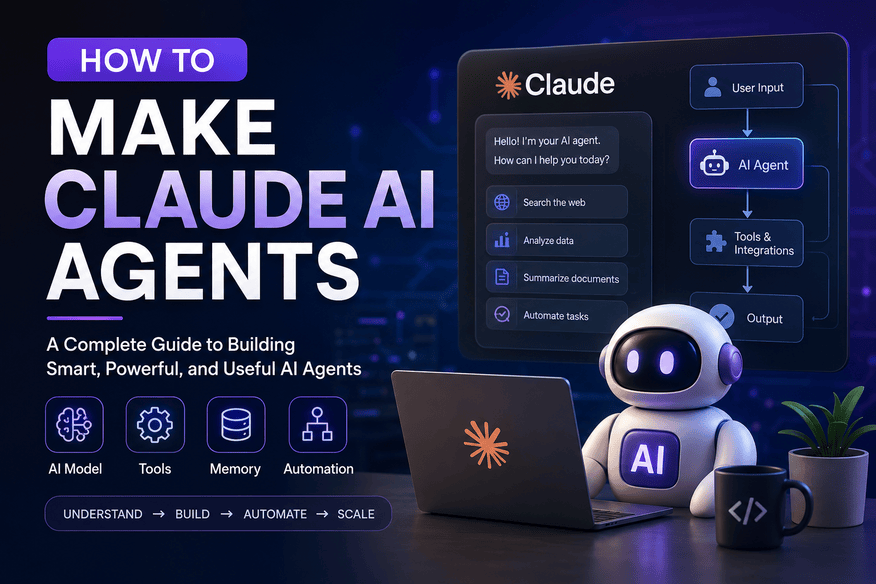

Introduction
Artificial intelligence has moved far beyond simple chatbots. Today, AI systems can research information, write code, automate workflows, summarize documents, and even collaborate with software tools in real time. At the center of this transformation is Anthropic’s Claude AI, one of the fastest-growing large language models in the world.
As businesses and creators search for smarter automation, one question appears everywhere online: how to make Claude AI agents.
The interest is understandable. Claude AI agents are becoming valuable for startups, marketers, developers, content creators, and enterprise teams because they combine natural conversation with advanced reasoning and workflow capabilities. Unlike traditional bots that only respond to messages, modern AI agents can perform actions, manage tasks, analyze data, and assist with real-world operations.
The rise of AI agents is not just another tech trend. It represents a major shift in how people interact with software and automation. Instead of manually handling repetitive tasks, users can now create intelligent assistants capable of working alongside humans.
This guide explores how Claude AI agents work, why they matter, and what it takes to build systems that are useful, reliable, and scalable.
Understanding Claude AI Agents
To understand how Claude AI agents work, it helps to first understand the difference between a chatbot and an AI agent.
A chatbot typically answers prompts in a conversation. An AI agent goes much further. It can:
- Analyze information
- Make decisions
- Use external tools
- Complete multi-step tasks
- Maintain memory across sessions
- Interact with APIs and software platforms
This is why AI agents are becoming increasingly popular in industries like customer support, software development, digital marketing, research, and productivity automation.
Claude models developed by Anthropic are especially well-suited for these systems because they are designed with strong reasoning capabilities, long-context understanding, and safety-focused AI behavior.
In practical terms, a Claude AI agent can:
- Summarize large research documents
- Generate SEO content
- Manage workflows
- Automate repetitive office tasks
- Write and debug code
- Act as a virtual assistant
- Support customer service operations
What makes these agents powerful is not just intelligence, but their ability to combine intelligence with action.
Why Claude AI Is Becoming Popular for AI Agents ?
The AI industry currently offers many large language models, but Claude has developed a strong reputation among developers and businesses.
One major reason is Claude’s ability to process extremely long conversations and documents. This makes it useful for applications involving:
- Legal analysis
- Research papers
- Business documentation
- Large codebases
- Knowledge management
Another advantage is its natural writing quality. Many users feel Claude produces responses that sound more conversational and human compared to other models.
Claude also performs particularly well in reasoning-heavy tasks. This is critical when building AI agents because agents often need to:
- Evaluate multiple possibilities
- Make logical decisions
- Follow instructions accurately
- Maintain consistent behavior
The official Anthropic API Documentation explains how developers can integrate Claude into applications, tools, and workflow systems.
As AI agents become more advanced, reasoning quality matters more than raw text generation. This is one reason why many developers are exploring Claude-based systems for automation projects.
The Growing Shift Toward AI-Powered Workflows
One of the biggest misconceptions about AI agents is that they are only useful for tech companies. In reality, nearly every industry can benefit from intelligent automation.
A modern AI agent can help businesses:
- Reduce repetitive work
- Improve response times
- Organize information
- Enhance productivity
- Scale customer interactions
For example, a marketing agency might use a Claude AI agent to:
- Research competitors
- Generate blog outlines
- Create ad copy
- Summarize analytics reports
- Schedule content ideas
A software team might use an agent for:
- Code reviews
- Documentation generation
- Bug explanations
- Internal knowledge retrieval
Meanwhile, content creators are increasingly using AI agents to streamline workflows across blogging, video scripting, email marketing, and social media management.
The technology is becoming less about replacing people and more about expanding human efficiency.
The Core Structure Behind Claude AI Agents
Although AI agents may appear magical from the outside, most follow a structured architecture.
At the center is the Claude model itself, which acts as the reasoning engine. Around it are several supporting systems that allow the agent to function effectively.
Prompt System
Every AI agent relies heavily on instructions. The prompt system defines:
- The agent’s personality
- Its objectives
- Communication style
- Behavioral rules
- Safety limitations
Well-designed prompts often determine whether an AI agent feels intelligent or unreliable.
Memory Systems
Memory is one of the most important elements in advanced agents.
Without memory, AI systems forget past interactions. With memory, they can:
- Recall previous conversations
- Store project details
- Maintain personalization
- Improve continuity
This is why many modern agent systems integrate vector databases like:
- Pinecone
- ChromaDB
- Weaviate
Memory transforms AI from a simple tool into a long-term assistant.
Tool Usage
The most powerful Claude AI agents are connected to external tools.
These tools may include:
- Web browsers
- Search engines
- CRMs
- Calendars
- Databases
- Email systems
- Slack
- Notion
- Google Workspace
When an AI model can interact with software tools, it becomes capable of performing real operational tasks rather than only generating text.
The Rise of Multi-Agent Systems
One of the most exciting developments in AI is the emergence of multi-agent collaboration.
Instead of using one AI assistant for everything, developers now create systems where multiple agents specialize in different tasks.
For example:
| Agent Role | Responsibility |
|---|---|
| Research Agent | Finds and analyzes information |
| Writing Agent | Creates content |
| Editing Agent | Improves clarity and grammar |
| SEO Agent | Optimizes keywords and metadata |
| Publishing Agent | Uploads and schedules content |
Frameworks like CrewAI and LangChain are helping developers build these collaborative AI systems more efficiently.
This approach mirrors how real human teams operate, which makes the workflow surprisingly effective.
Why Businesses Are Investing in Claude AI Agents ?
The rapid adoption of AI agents is largely driven by economics and efficiency.
Companies are constantly searching for ways to:
- Lower operational costs
- Increase productivity
- Improve customer experiences
- Handle growing workloads
AI agents can operate continuously without fatigue, making them attractive for repetitive or time-consuming tasks.
Customer support is one of the clearest examples. A Claude AI agent can:
- Handle frequently asked questions
- Route support tickets
- Summarize customer issues
- Draft responses for human agents
This reduces workload while improving response speed.
Similarly, businesses managing large amounts of content or data can use agents to automate organization and analysis tasks that would otherwise consume hours of manual labor.
The Human Side of AI Agents
Despite the excitement surrounding automation, the most successful AI systems are usually designed with human collaboration in mind.
Fully autonomous AI agents still face limitations:
- Hallucinations
- Inaccurate assumptions
- Poor decision-making in edge cases
- Limited real-world awareness
Because of this, many experienced developers recommend keeping humans involved in critical workflows.
The most effective systems often combine:
- AI speed
- Human judgment
- Automated workflows
- Manual oversight
This hybrid approach produces better long-term reliability and trust.
Challenges Developers Face When Building AI Agents
While AI agents sound exciting, building them effectively is not always easy.
One common issue is unreliable prompting. Small wording changes can dramatically affect behavior.
Another challenge is memory management. Agents may lose context or retrieve irrelevant information if memory systems are poorly configured.
Cost management is another growing concern. Large AI workflows can become expensive if token usage is not optimized properly.
Security also matters. Agents connected to tools or sensitive data require strong permission systems and careful monitoring.
This is why experienced developers emphasize gradual development instead of trying to create fully autonomous systems immediately.
The Future of Claude AI Agents
AI agents are evolving rapidly.
Over the next few years, experts expect major improvements in:
- Voice interaction
- Real-time collaboration
- Autonomous browsing
- Workflow orchestration
- AI operating systems
- Multi-agent teamwork
The idea of AI employees assisting human teams is becoming increasingly realistic.
Businesses are already experimenting with AI-powered project managers, researchers, analysts, and customer support assistants.
What seems advanced today may soon become a standard part of daily work.
Final Thoughts
Learning how to make Claude AI agents is about more than understanding APIs or automation frameworks. It’s about understanding how intelligent systems can support real human work.
Claude AI has become a strong foundation for these systems because of its reasoning ability, natural language quality, and long-context performance. Whether someone is building a research assistant, content workflow, coding helper, or productivity system, Claude offers the flexibility needed for modern AI applications.
The most important lesson is that successful AI agents are not built overnight. They evolve through experimentation, testing, and gradual improvement.
The future of AI belongs not only to developers, but also to creators, businesses, entrepreneurs, and everyday users who learn how to collaborate effectively with intelligent systems.
And this transformation is only beginning.
FAQs
What is a Claude AI agent?
A Claude AI agent is an intelligent system powered by Claude models that can perform tasks, make decisions, use tools, and automate workflows.
Is Claude AI good for automation?
Yes. Claude AI is widely used for automation because of its strong reasoning, natural language understanding, and ability to handle long-context tasks.
Can beginners build Claude AI agents?
Yes. Many no-code and low-code platforms now make it easier for beginners to create simple AI agents without advanced programming knowledge.
What industries use AI agents?
AI agents are used in marketing, software development, customer support, education, research, healthcare, productivity, and business automation.
Are Claude AI agents expensive to run?
Costs depend on API usage, workflow complexity, and model size. Small projects can remain affordable with efficient optimization.
Suggested Internal Links
- Best AI Tools for Content Creators
- AI Automation for Beginners
- Claude vs ChatGPT Comparison
- How AI Agents Are Changing Business