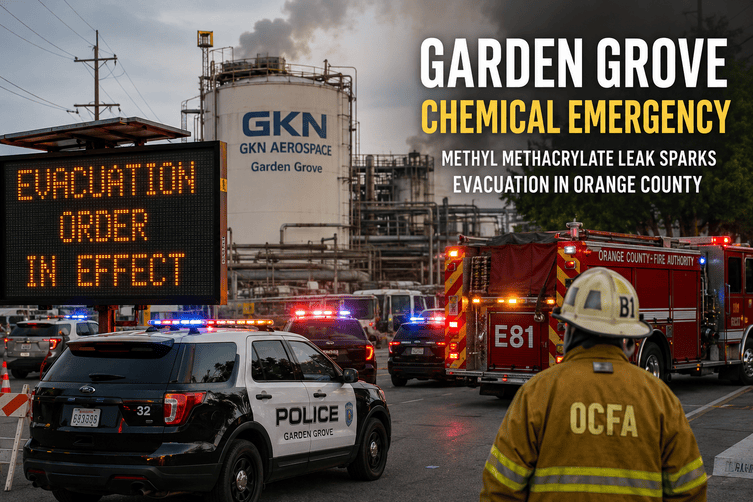

When most people think of Garden Grove, California, they picture family neighborhoods, Vietnamese food culture, and the busy heart of Orange County. But this week, the city made national headlines for something far more alarming — a dangerous chemical emergency tied to GKN Aerospace Garden Grove that forced thousands of residents under an urgent evacuation order.
The incident quickly became one of the biggest developing stories in Garden Grove news today, with residents scrambling to leave homes while emergency crews from OCFA worked nonstop to prevent a potential explosion.
At the center of the crisis was a volatile chemical called methyl methacrylate, stored in a massive industrial tank at the aerospace facility. Officials warned the tank could either rupture or explode, creating fear across multiple Orange County communities.
The story wasn’t just about a “gas leak Garden Grove” situation. It became a broader conversation about industrial safety, emergency preparedness, and how modern cities coexist with hazardous manufacturing facilities.
What Happened in Garden Grove ?
According to reports from the Orange County Fire Authority (OCFA), firefighters responded to a hazardous materials emergency at the GKN Aerospace facility on Western Avenue in Garden Grove. The facility reportedly contained a 34,000-gallon tank holding methyl methacrylate (MMA) — a highly flammable industrial chemical used in aerospace plastics manufacturing.
Officials said the tank overheated and began venting chemical vapors into the air, triggering immediate concern among emergency responders.
The situation escalated when crews discovered an inoperable valve that prevented them from safely stabilizing the tank. That’s when evacuation orders rapidly expanded across parts of:
- Garden Grove
- Anaheim
- Cypress
- Stanton
- Westminster
- Buena Park
Authorities estimated nearly 40,000 people were affected.
What Is Methyl Methacrylate?
For many residents following the garden grove news, the first big question was simple:
“What exactly is methyl methacrylate?”
Methyl methacrylate is a chemical commonly used in:
| Industry | Purpose |
|---|---|
| Aerospace | Acrylic plastic components |
| Automotive | Lightweight plastics |
| Construction | Resins and adhesives |
| Medical | Bone cement and dental materials |
| Beauty Industry | Acrylic nail products |
Despite its common industrial uses, MMA can become extremely dangerous under heat or pressure.
According to emergency officials and EPA references cited in coverage, exposure may cause:
- Eye irritation
- Respiratory distress
- Dizziness
- Chest tightness
- Skin reactions
- Potential fire or explosion hazards
One detail that stood out during the emergency was how officials repeatedly emphasized that the chemical vapors were “highly volatile” and “highly flammable.”
That language alone told residents this was far beyond a routine industrial incident.
Why the Garden Grove Gas Leak Became So Serious ?
A standard industrial leak is dangerous enough. But the Garden Grove chemical accident became uniquely alarming because officials publicly admitted there were only two possible outcomes:
- The tank could fail and spill thousands of gallons of toxic chemicals
- The tank could explode
That stark warning changed public perception immediately.
In many emergencies, authorities reassure residents. Here, emergency officials openly acknowledged uncertainty.
That honesty may have helped people understand the seriousness of the situation, but it also fueled fear across Orange County social media channels and local communities.
Reddit discussions from Orange County residents showed growing anxiety, especially among families living near the evacuation zones.
Some residents described hearing emergency sirens throughout the night, while others worried about exposure risks for elderly family members or children.
The Role of GKN Aerospace Garden Grove
The facility involved in the incident belongs to GKN Aerospace, a global aerospace engineering company that manufactures aircraft components for commercial and military aviation.
The GKN Aerospace Garden Grove site reportedly uses MMA in plastic manufacturing operations tied to aerospace production.
Large-scale aerospace manufacturing often requires chemicals that are:
- Heat sensitive
- Flammable
- Pressure reactive
- Hazardous if improperly stored
The incident raises larger questions about how industrial facilities operate within densely populated suburban regions like Orange County.
Garden Grove is not a remote industrial town. Schools, neighborhoods, shopping centers, and businesses sit close to manufacturing sites.
That proximity made the emergency especially unsettling.
How OCFA Responded ?
The Orange County Fire Authority (OCFA) became the public face of the emergency response.
Their crews worked continuously to:
- Cool the overheating tank
- Monitor vapor levels
- Build containment barriers
- Coordinate evacuations
- Prevent contamination runoff
- Communicate with residents
Officials also established evacuation centers and used multilingual communication to reach Orange County’s diverse communities, including Vietnamese-speaking residents in Garden Grove.
One of the more remarkable aspects of the response was the level of transparency provided during press conferences.
Rather than minimizing the situation, OCFA openly described the operational difficulties and potential consequences.
That approach likely helped residents take evacuation orders more seriously.
Evacuation Order Garden Grove: What Residents Experienced ?
For many locals, the evacuation order Garden Grove situation felt surreal.
Imagine waking up to alerts warning that a nearby industrial tank could explode.
Road closures expanded quickly. Schools shut down. Businesses evacuated employees. Traffic intensified across Orange County.
Some residents reportedly refused to leave despite warnings.
That reaction reflects a common challenge in emergency management:
People often underestimate risks until visible disaster occurs.
But chemical emergencies are different from fires or storms. The danger may be invisible, odor-based, or airborne.
And because methyl methacrylate vapors can travel and ignite, officials had to assume worst-case scenarios.
Why This Story Matters Beyond Garden Grove California ?
This wasn’t just a local Garden Grove CA headline.
The incident exposed broader national concerns:
1. Aging Industrial Infrastructure
Many industrial facilities across the United States operate with aging tanks, valves, and chemical systems.
A single failed component can create regional emergencies.
2. Urban Expansion Around Industrial Sites
Cities like Garden Grove California have grown rapidly over decades.
Residential communities now surround facilities originally built in less populated areas.
That increases public risk during chemical incidents.
3. Public Awareness of Hazardous Materials
Most people never think about what chemicals exist near their homes.
This event reminded Orange County residents that advanced manufacturing depends on substances that can become dangerous under certain conditions.
Community Reaction Across Orange County
One fascinating aspect of the crisis was how quickly community-driven information spread online.
Local Reddit discussions became real-time information hubs for:
- Evacuation updates
- Shelter locations
- Traffic conditions
- Safety concerns
- OCFA announcements
Some residents even translated updates for family members or neighbors unfamiliar with English emergency broadcasts.
That kind of grassroots communication often becomes essential during fast-moving emergencies.
Safety Lessons From the Garden Grove Chemical Accident
Here are several important takeaways from the incident:
| Lesson | Why It Matters |
|---|---|
| Take evacuation orders seriously | Chemical risks may not be visible |
| Keep emergency alerts enabled | Early warnings save lives |
| Know nearby industrial facilities | Awareness improves preparedness |
| Have evacuation essentials ready | Emergencies happen unexpectedly |
| Follow verified sources | Rumors spread quickly online |
Could This Happen Again ?
Unfortunately, yes.
Industrial chemical incidents happen more often than most people realize. What made the garden grove gas leak unusual was its scale, visibility, and proximity to dense suburban populations.
Experts will likely investigate:
- Why the tank overheated
- Whether maintenance systems failed
- How emergency protocols performed
- Whether regulations need strengthening
The answers may shape future industrial safety policies in California and beyond.
Final Thoughts
The Garden Grove chemical accident transformed an ordinary Orange County community into the center of a major hazardous materials emergency.
For residents, it was a reminder that modern infrastructure carries hidden risks. For emergency responders, it became a high-pressure test of coordination and crisis management. And for the rest of the country, it highlighted the fragile balance between industrial progress and public safety.
What stands out most is not just the danger itself — but how quickly communities, emergency crews, and local agencies mobilized to protect lives.
The story of Garden Grove news today is ultimately about preparedness, transparency, and resilience under uncertainty.
FAQs
What caused the Garden Grove chemical accident?
Officials say an overheating tank containing methyl methacrylate at the GKN Aerospace facility triggered the hazardous materials emergency.
What is methyl methacrylate used for?
Methyl methacrylate is commonly used in plastics, aerospace manufacturing, adhesives, and acrylic products.
Why was there an evacuation order in Garden Grove?
Authorities feared the chemical tank could rupture or explode, potentially releasing toxic and flammable chemicals into nearby communities.
Which agency handled the emergency response?
The Orange County Fire Authority (OCFA) led the hazmat and evacuation operations.
Was Disneyland affected by the evacuation?
Reports stated Disneyland was outside the evacuation zone.
External Links
- Orange County Fire Authority (OCFA)
- Environmental Protection Agency – Methyl Methacrylate Information
- GKN Aerospace Official Website
Conclusion
The Garden Grove chemical accident was more than just another breaking headline in Orange County — it became a powerful reminder of how quickly industrial emergencies can impact entire communities. From the dangerous methyl methacrylate leak at GKN Aerospace Garden Grove to the massive evacuation order Garden Grove residents faced, the incident exposed the real-world risks hidden behind modern manufacturing and urban growth.
What made this story especially significant was the response. Agencies like OCFA acted rapidly to contain the threat, protect residents, and communicate updates during a highly uncertain situation. At the same time, local communities across Garden Grove CA showed resilience by supporting neighbors, sharing information, and following safety protocols during the emergency.
As investigations continue, many residents are now asking important questions about industrial safety, emergency preparedness, and how cities like Garden Grove California can better protect families living near hazardous facilities. The answers could shape future regulations and emergency planning not only in Orange County, but across California as well.
For now, the incident stands as a critical lesson: preparedness, transparency, and fast emergency response can make the difference between chaos and catastrophe.
If you found this article helpful, share it with others, stay updated with the latest Garden Grove news today, and explore more local safety and emergency preparedness guides on our website.