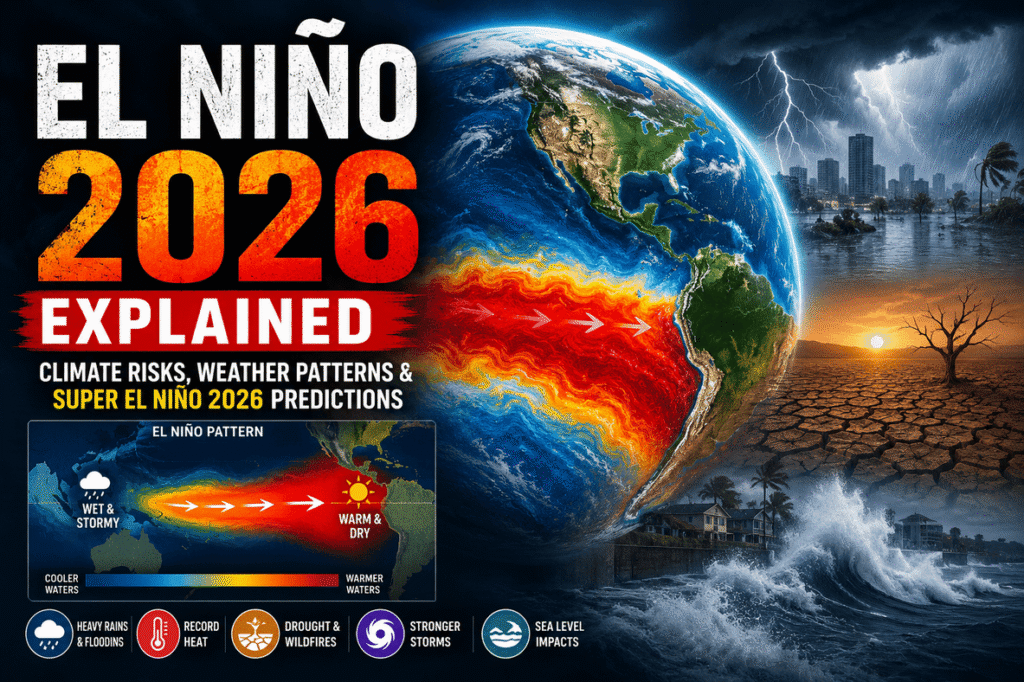

The phrase “El Niño” often appears in headlines whenever extreme weather strikes—floods in one region, droughts in another, or unusually warm global temperatures. But in 2026, scientists and climate watchers are paying even closer attention to the possibility of El Niño 2026 evolving into a stronger climate event, with some experts already discussing the potential for a Super El Niño 2026 scenario.
What makes El Niño so fascinating is that it begins far away from most people’s daily lives—in the tropical Pacific Ocean—yet its effects can influence nearly every continent on Earth. From crop failures and water shortages to stronger storms and rising food prices, El Niño is far more than just a weather pattern.
In this guide, we’ll break down what El Niño really is, why scientists are monitoring 2026 closely, and how a future Super El Niño could affect weather, economies, and ordinary people worldwide.
What Is El Niño?
El Niño is a natural climate pattern caused by unusually warm ocean temperatures in the central and eastern Pacific Ocean near the equator. It is part of a larger climate cycle called the El Niño-Southern Oscillation (ENSO).
Normally, trade winds push warm water westward toward Asia and Australia. During El Niño years, these winds weaken. Warm water shifts eastward toward the Americas, disrupting atmospheric circulation and changing weather patterns globally.
According to the National Oceanic and Atmospheric Administration (NOAA), El Niño events typically occur every 2–7 years and can last anywhere from several months to more than a year.
Why Is El Niño 2026 Getting Attention ?
Climate scientists are increasingly concerned about the interaction between natural El Niño cycles and long-term global warming.
After recent record-breaking temperatures worldwide, meteorologists are closely monitoring Pacific Ocean conditions for signs of another warming event. While exact forecasts continue evolving, discussions around El Niño 2026 have intensified because even a moderate event could amplify already extreme climate conditions.
Several factors are driving concern:
- Oceans remain historically warm
- Global average temperatures continue rising
- Weather systems are becoming more volatile
- Previous strong El Niño events caused massive economic losses
Many experts remember the devastating 2015–2016 El Niño, which contributed to droughts, coral bleaching, wildfires, and severe flooding around the globe.
What Is a Super El Niño ?
A Super El Niño refers to an exceptionally powerful El Niño event. These rare events produce stronger-than-normal ocean warming and often trigger more intense global impacts.
Historically, only a few Super El Niño events have been recorded, including:
| Year | Major Impacts |
|---|---|
| 1982–83 | Severe flooding, crop damage, economic losses |
| 1997–98 | Massive storms, floods, coral bleaching |
| 2015–16 | Record global heat, droughts, wildfire conditions |
A possible Super El Niño 2026 would not simply mean warmer temperatures. It could reshape rainfall patterns, agricultural productivity, and even energy markets worldwide.
How El Niño Changes Global Weather ?
One reason El Niño receives so much media attention is because its effects are incredibly widespread.
1. Increased Rainfall and Flooding
Some regions become dramatically wetter during El Niño years.
Areas commonly affected include:
- Western South America
- Southern United States
- East Africa
Heavy rainfall can lead to:
- Flash floods
- Landslides
- Infrastructure damage
- Water contamination
For developing countries, even a short period of extreme rainfall can overwhelm drainage systems and destroy homes.
2. Drought Conditions
While some places get too much rain, others experience severe drought.
Countries often affected include:
- Australia
- Indonesia
- India (weakened monsoons)
- Parts of southern Africa
Drought can damage:
- Food production
- Hydropower generation
- Livestock farming
- Drinking water supplies
This uneven distribution of rainfall is one reason El Niño has major economic consequences.
3. Hotter Global Temperatures
El Niño years are often among the hottest years ever recorded.
When warm Pacific waters release additional heat into the atmosphere, global temperatures tend to rise significantly. Combined with ongoing climate change, this warming effect becomes even stronger.
Organizations like NASA Climate and World Meteorological Organization have repeatedly linked strong El Niño events with record-breaking global heat.
4. Changes in Hurricane Activity
El Niño also influences tropical storms.
Atlantic Ocean
- Often fewer hurricanes
- Increased wind shear disrupts storm formation
Pacific Ocean
- Usually more tropical cyclones
- Stronger storm development possible
This means one region may see reduced storm risks while another faces elevated danger.
Could Super El Niño 2026 Affect Food Prices ?
Absolutely.
One of the less discussed effects of El Niño is its impact on agriculture and global food supply chains.
Climate disruptions can reduce yields of:
- Wheat
- Rice
- Corn
- Coffee
- Cocoa
For example:
- Droughts hurt rice production in Asia
- Excessive rain damages crops in South America
- Fisheries decline due to warmer ocean temperatures
When multiple agricultural regions suffer simultaneously, food prices often rise globally.
This is why economists monitor El Niño almost as closely as meteorologists.
El Niño and Climate Change: A Dangerous Combination
A major debate in climate science today is whether global warming is making El Niño events stronger or more unpredictable.
While researchers continue studying the connection, there is growing evidence that warmer oceans may intensify extreme climate swings.
The concern isn’t just about hotter temperatures—it’s about instability.
A warmer atmosphere holds more moisture, which can increase:
- Extreme rainfall
- Stronger storms
- Flood intensity
- Heatwave severity
In other words, a future Super El Niño 2026 could occur in a world already stressed by climate change, making impacts more severe than historical events.
The Intergovernmental Panel on Climate Change (IPCC) has repeatedly warned that overlapping climate risks are becoming increasingly dangerous.
Key Differences: Normal El Niño vs Super El Niño
| Feature | Normal El Niño | Super El Niño |
|---|---|---|
| Ocean warming | Moderate | Extreme |
| Weather disruptions | Regional | Global |
| Economic impact | Noticeable | Severe |
| Flood and drought risk | Elevated | Very high |
| Global temperature effect | Moderate | Record-breaking potential |
How Countries Prepare for El Niño ?
Governments and climate agencies now invest heavily in forecasting systems to reduce damage from El Niño events.
Preparation strategies include:
Early Warning Systems
Meteorological agencies track ocean temperatures and atmospheric changes months in advance.
Water Management
Countries facing drought risks store water and improve irrigation planning.
Disaster Preparedness
Flood-prone regions strengthen emergency response systems.
Agricultural Planning
Farmers may adjust planting schedules or switch crop varieties.
Preparation matters because even a few weeks of advanced warning can save lives and reduce economic losses.
Personal Perspective: Why El Niño Feels Different Today ?
In previous decades, El Niño was mostly discussed in scientific communities. Today, ordinary people are noticing unusual weather patterns themselves.
Heatwaves are lasting longer.
Storms feel more destructive.
Rainfall patterns seem unpredictable.
What makes El Niño 2026 especially important is that public awareness of climate risks has dramatically increased. Social media, satellite tracking, and instant weather reporting mean people experience climate events in real time.
For younger generations, El Niño is no longer just a scientific term—it’s becoming part of everyday conversation about climate uncertainty and future planning.
Common Myths About El Niño
Myth 1: El Niño Causes All Extreme Weather
Not true. Many factors influence weather systems, including climate change and regional patterns.
Myth 2: Every El Niño Is the Same
Each event varies in intensity, duration, and global impact.
Myth 3: El Niño Only Affects Coastal Areas
False. Its effects can influence rainfall, heat, and agriculture far inland.
What Scientists Are Watching Right Now ?
Climate researchers are currently monitoring:
- Pacific Ocean surface temperatures
- Trade wind strength
- Atmospheric pressure shifts
- Ocean heat content
Forecast models continue changing as new data arrives, so predictions about Super El Niño 2026 remain uncertain.
Still, the increasing global focus shows how seriously climate experts take the possibility of another major event.
For updated forecasts, readers can follow:
FAQs About El Niño
What causes El Niño?
El Niño is caused by warming ocean temperatures in the central and eastern Pacific combined with weakened trade winds.
Is El Niño 2026 confirmed?
Scientists are monitoring conditions closely, but long-term forecasts continue evolving as new ocean data becomes available.
What is a Super El Niño?
A Super El Niño is an unusually strong El Niño event capable of causing severe global climate disruptions.
Does El Niño affect Pakistan?
Yes. El Niño can influence South Asian monsoons, rainfall patterns, and temperature extremes across the region.
How long does El Niño last?
Most El Niño events last between 9 and 12 months, though some continue longer.
Conclusion
El Niño has always been one of Earth’s most powerful climate patterns, but today it exists within a rapidly warming world. That changes the stakes dramatically.
Whether or not Super El Niño 2026 fully develops, scientists agree on one thing: climate volatility is increasing. Understanding El Niño is no longer just for meteorologists—it matters to farmers, businesses, governments, and families everywhere.
The coming years may test how prepared the world truly is for overlapping climate challenges.
If you found this guide helpful, share it with others interested in climate science, weather trends, and the future of our planet. You can also explore more climate and environmental content on your blog to stay ahead of emerging global issues.